Regenerating Degraded Pastures with Agroforestry
From Bare Ground to Food Forest: How We're Bringing a Degraded Pasture Back to Life
By: Javier Abdelnour
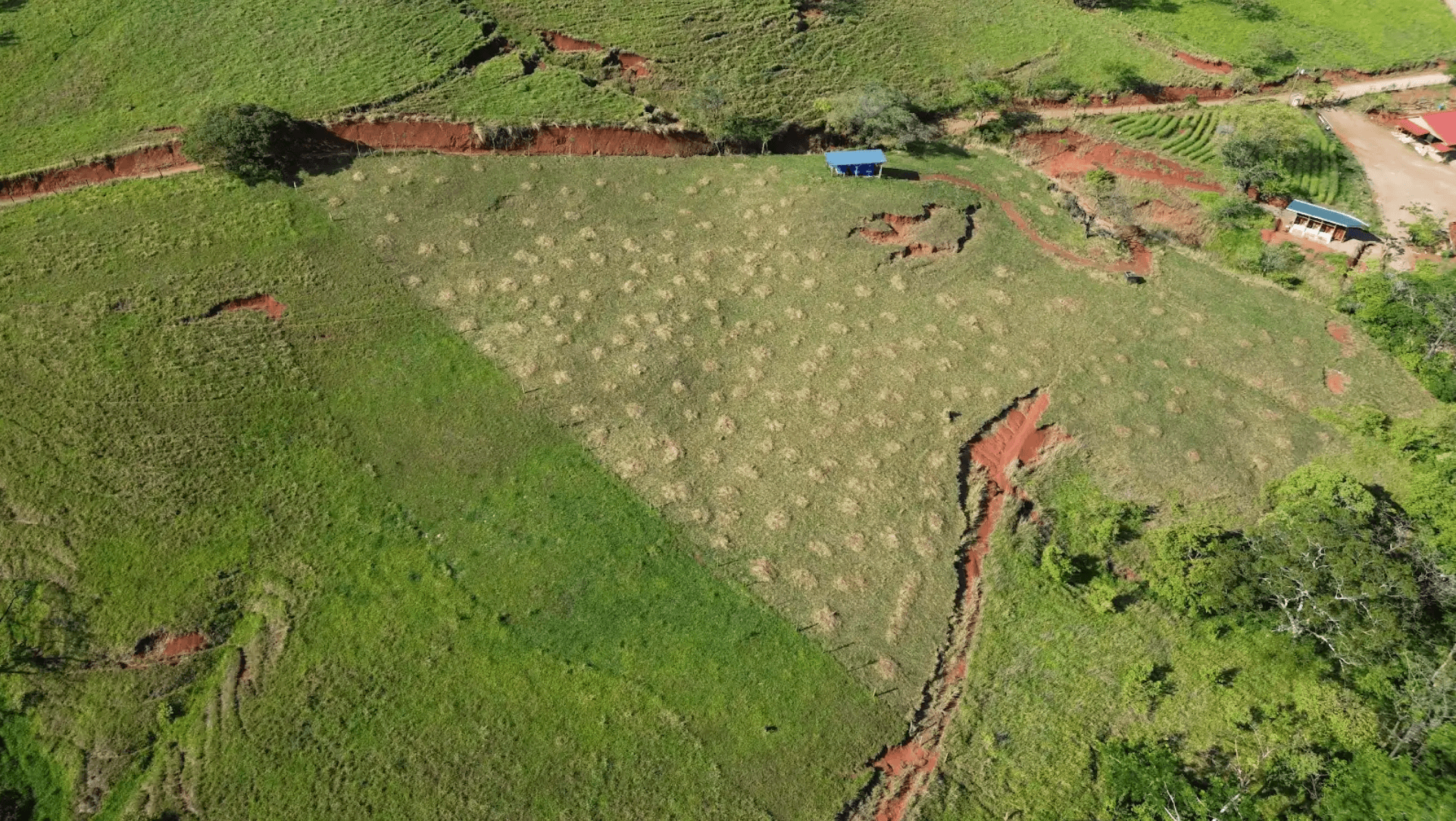
There is a particular kind of silence that falls over a degraded pasture in the dry tropical region of Guanacaste. The sun is harsh, there is no birdsong, no canopy that intercepts the strong winds, no insects humming. It feels so unnatural, so out of place, like something isn’t right. You can’t help but feel vulnerable, unprotected, and exposed to the elements.
When we first started studying the land that would become our Ojoche Agroforestry System, this is what we felt. Similar to the rest of the farm, this paddock felt like it had been grazed past its limits, stripped of its trees, continuously set-back in its succession process. Most people would have seen a problem and felt discouraged, but we saw an opportunity.
Even though the land looked bare, we weren't starting from scratch. A year earlier, we had planted our first agroforestry system on the farm, the Canelo Bowl, and it had taught us more than any course or book could. We knew what worked, what we'd do differently, and we felt ready to expand. So we started sketching.
Designing a new agroforestry system is one of the most exciting things we do at Tierramor, and one of the most overwhelming. The possibilities are almost endless, so we needed some constraints. After some deliberation, we landed on a clear objective: calorie-dense, perennial food production for our growing community, while at the same time bringing back the dry tropical forest to the paddock. Nut trees were the obvious anchor. They live for decades, they build soil rather than deplete it, and once established, they produce abundantly with very little input. But which species? Which nut trees would thrive in this harsh, dry climate, and ideally, which ones actually belonged here? We brought that question to Scott Gallant, one of our mentors. He answered without a pinch of doubt: the Ojoche (Brosimum alicastrum).
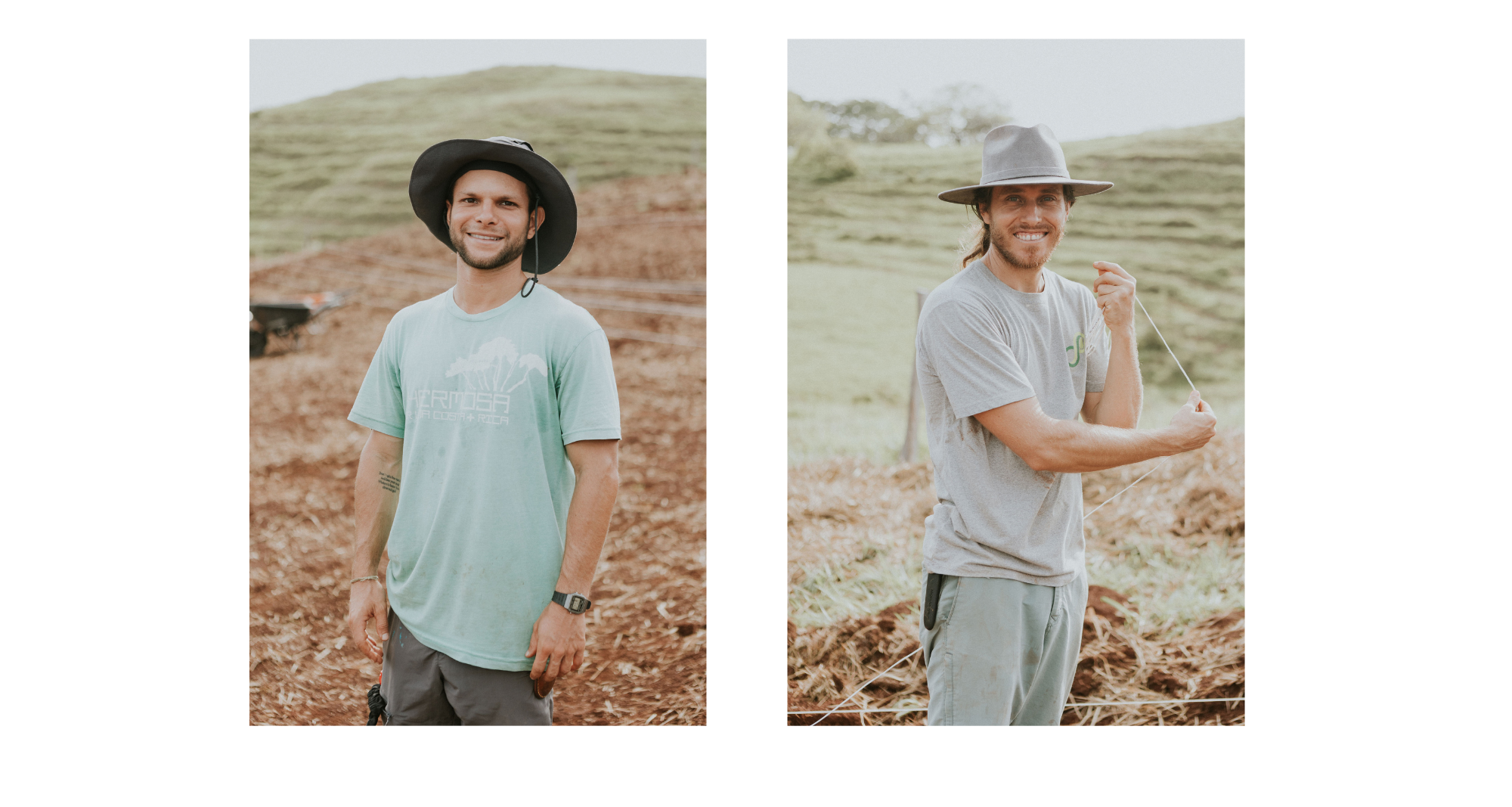
Javier Abdelnour (left), Farm Manager at Tierramor, and Scott Gallant (right) of Porvenir Design.
The Ojoche is a species with deep roots in this region, ecologically, historically, and culturally, and it turned out to be exactly what this land was asking for. But that's a story for our next article.
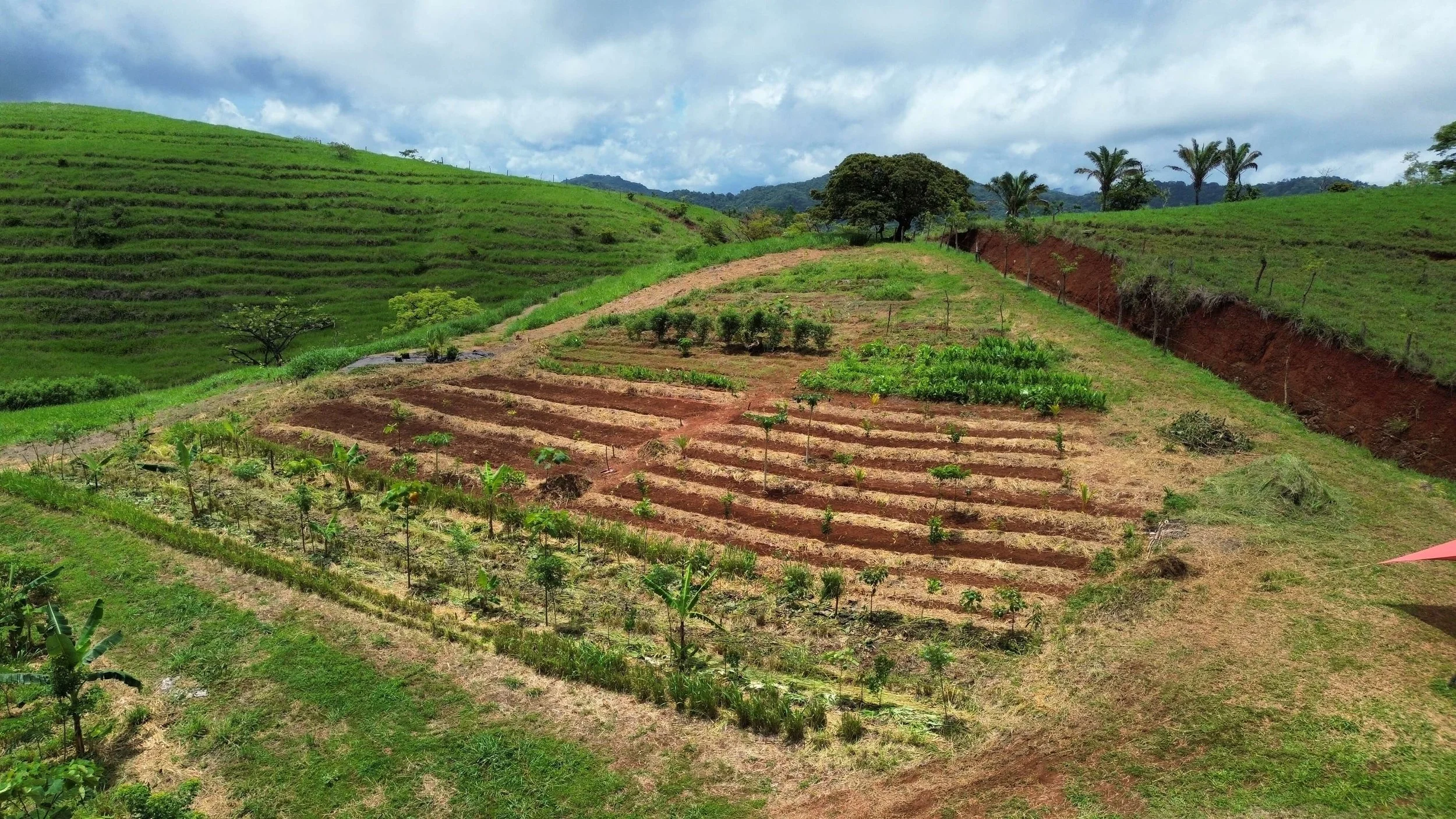
With our species list taking shape, Ojoche anchoring the canopy, bananas, mangoes and cashew trees filling the high strata, citrus occupying the middle strata, and ginger and turmeric blanketing the ground, the next challenge was orientation. We were working on a relatively steep hill, with a road running across the slope at the top that intercepted the rainwater flowing down from above. Get the row orientation wrong and we'd either accelerate erosion or make the system nearly impossible to manage. Should we plant on-contour, following the slope's natural lines to slow water movement? Or off-contour, which felt like going against everything the textbooks say? Our mentor Nat Muget offered a different perspective: in Brazil, she told us, they almost always plant off-contour. It's simply easier on the body, no more working with one foot higher than the other, and with machinery, the difference is significant. The key, she said, was keeping the soil covered at all times. It sounded counterintuitive. It also sounded worth testing. So we did something that would become a theme in this project: we split the difference. The upper section would be planted on-contour. The lower section, off-contour. Let the land tell us what worked.
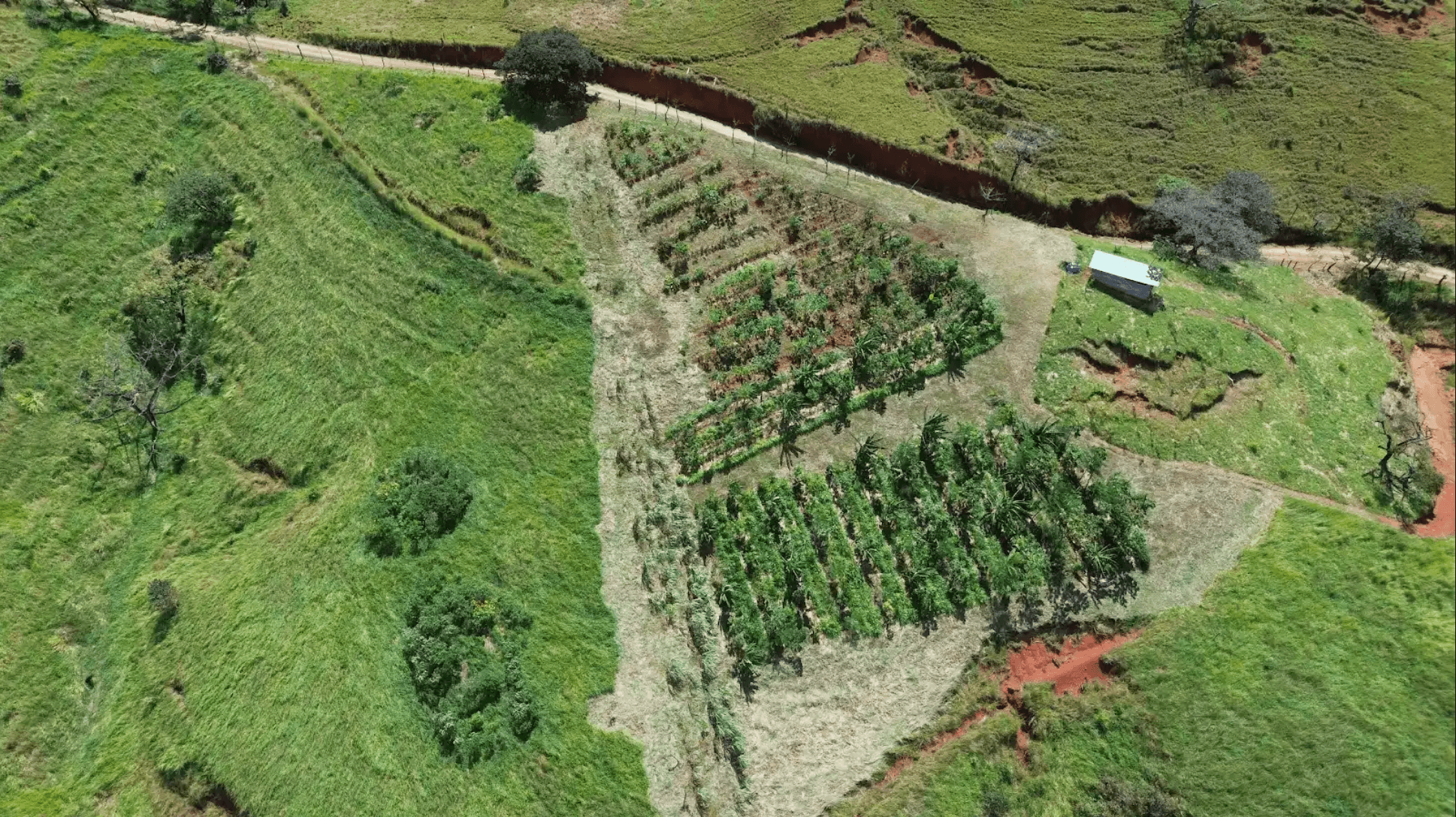
With the design finalized, it was time to stop drawing lines on paper and start moving earth. Our neighbor Jouvanie brought his tractor to tackle the first task: breaking up the dense mats of Brachiaria brizantha grass that had dominated this land for years. For anyone familiar with regenerative agriculture, tilling might raise a red flag. And rightly so, repeated tillage is devastating to soil life. Think of it like a massive earthquake hitting a city. Suppose the community survives, rebuilds, starts recovering, and then another earthquake hits. Do that enough times and nothing grows back. But this was a one-time reset, we wouldn’t need to do it ever again. The Brachiaria was actively shaping the soil microbiome around its own needs, cultivating a bacteria-dominant environment that would keep regenerating itself at the expense of everything else we wanted to grow. To shift this land toward forest, we needed to shift that ratio: less bacteria dominance, more fungal networks, the kind that support trees. Tilling, done once and never again, was how we'd break the cycle.
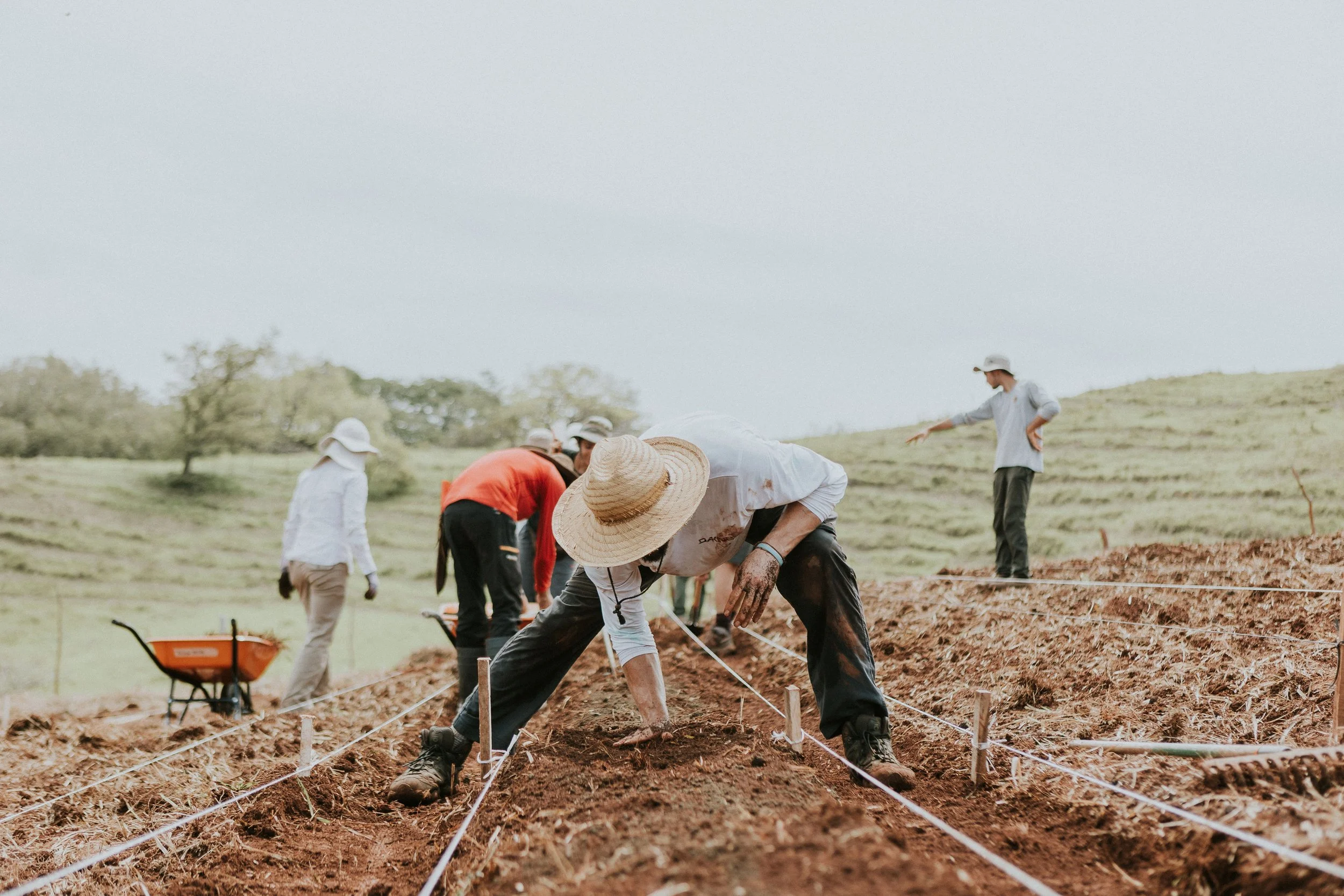
In just a couple of hours, Jouvanie had done what would have taken us weeks by hand. We stood at the edge of 4,500 square meters of exposed soil: raw, vulnerable, baking under the Guanacaste sun. Bare soil is never a good thing. Every hour it sits uncovered it loses moisture, structure, and life. We needed to get things in the ground fast, but we didn't have nearly enough organic material to cover the area, and our team alone couldn't plant 4,500 square meters in any reasonable amount of time. The course was in two weeks, and we felt relieved. Thirty pairs of hands, two full mornings, and a shared intention to bring this land back to life. Maybe the timing was exactly right.
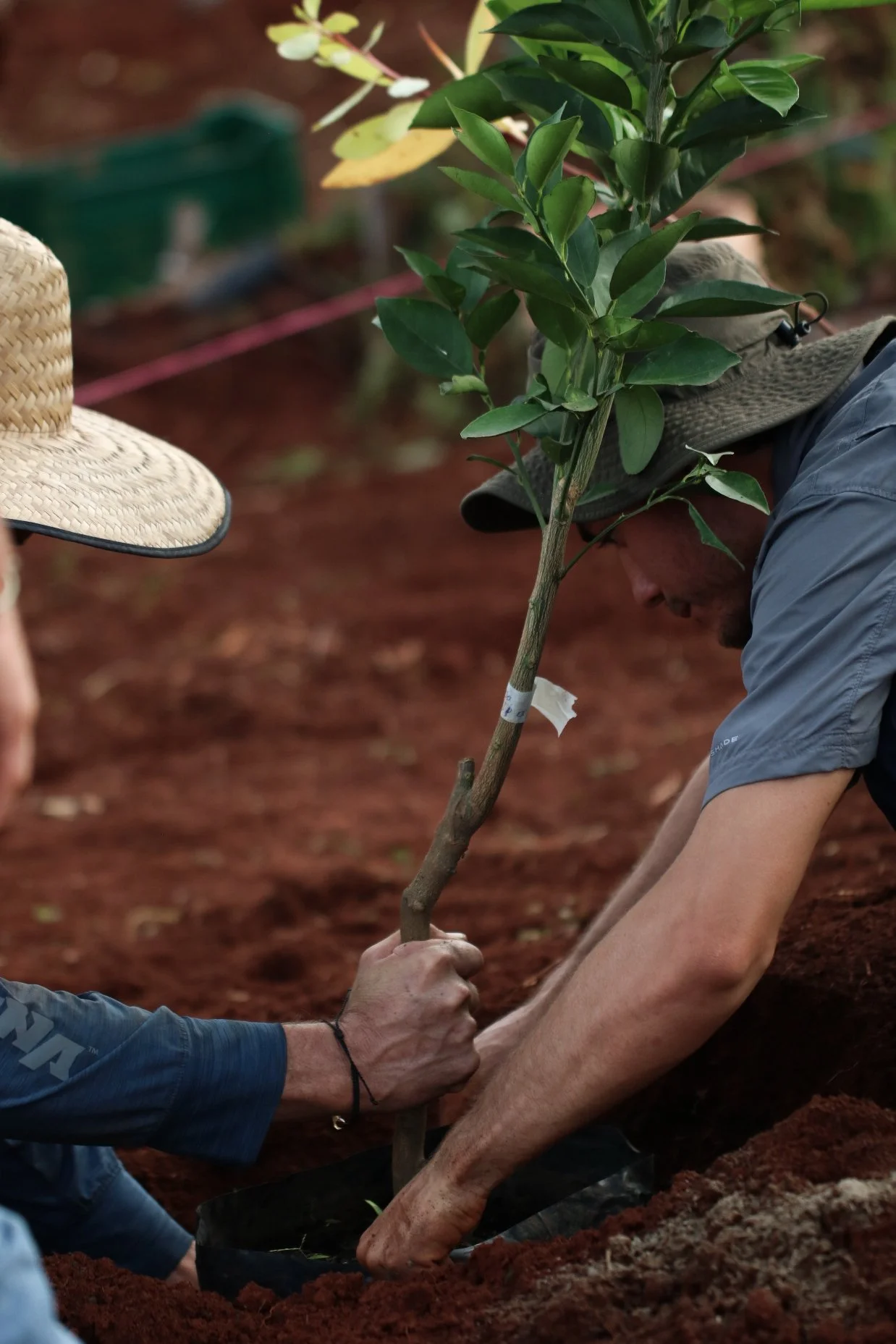
In May 2023, Tierramor hosted its first Syntropic Agroforestry course, brought together by three facilitators who between them represented some of the most rigorous practical knowledge in the field: Scott Gallant from Porvenir Design, Nat Muguet from Sitio Semente, and Jorge Espinosa from Agrosintrópica. Thirty-five participants, including several of our own staff, spent four days and three nights knee-deep in the work. We split the group into smaller teams and handed each one a section of the field. We covered the theory in the classroom and tested it out there every morning and afternoon. By the end of the fourth morning, all of the off-contour rows were fully planted, along with two rows of the on-contour section. And then, as if the land had been waiting, the rains came. That same weekend, the first storms of the rainy season arrived, right on cue.
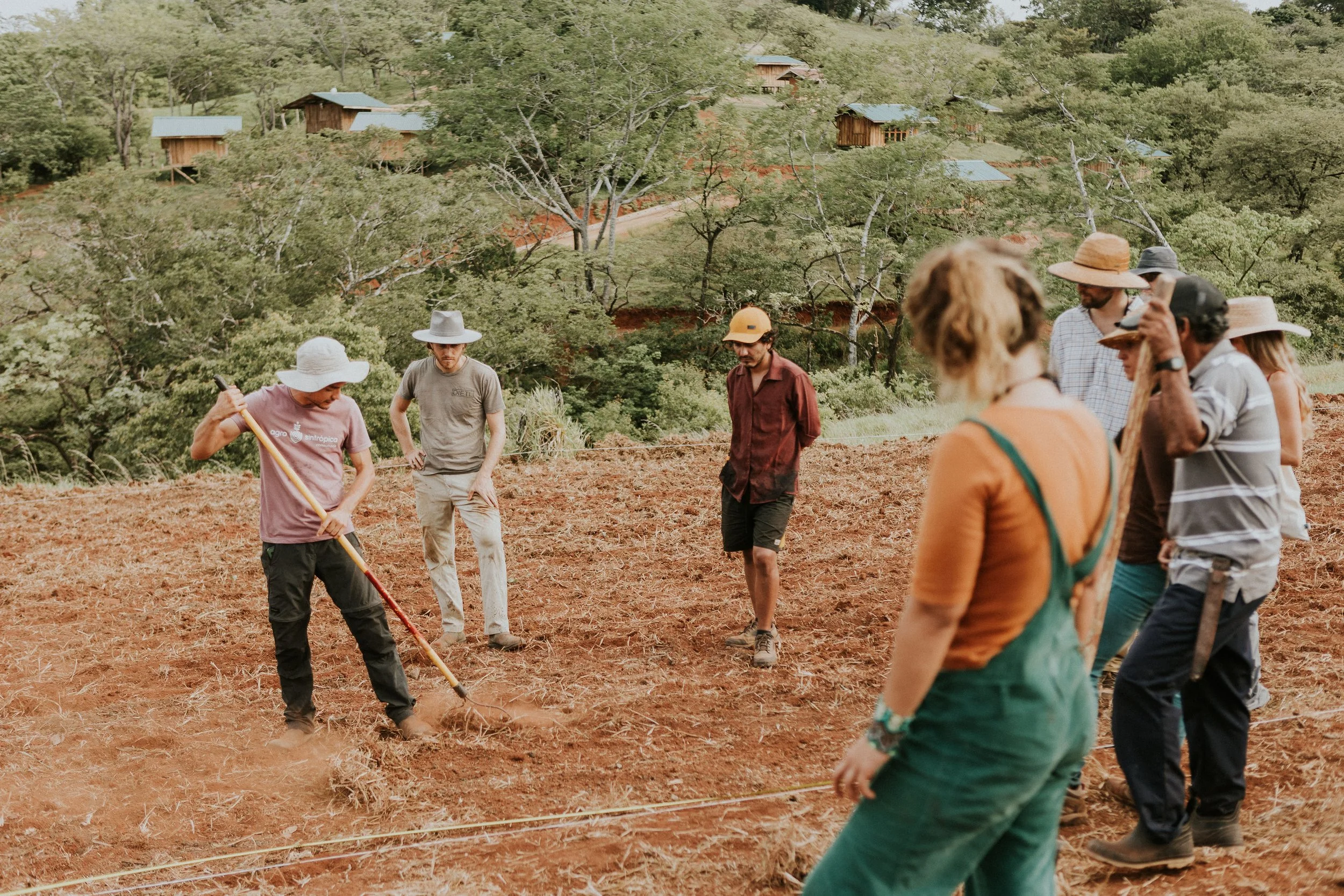
The months that followed the first planting were full of surprises, most of them good. The muvuca, the dense mix of seeds we had broadcast across the rows, began to germinate almost immediately. Within weeks, species we hadn't even consciously planned for were pushing through the soil, filling every available space. It was chaotic, beautiful, and slightly overwhelming. We spent the first year in a constant cycle of pruning, weeding, and observing, trying to understand what was growing, why it was there, and what role it was playing in the succession process. Many of the plants we didn't even recognize at first. That forced us to slow down and pay attention in a way that no course had ever taught us.
We also learned something humbling about our fruit trees. Most of them had come from a nursery, grafted specimens in bags, healthy and well-established by the time we planted them. They did fine. But the trees we had planted directly from seed? They did better. Noticeably better. They grew faster, fuller, and with a kind of vigor that the nursery trees couldn't match. It was a quiet but important lesson about the difference between a plant adapted to its exact conditions from its very first root and one that arrives already shaped by somewhere else.
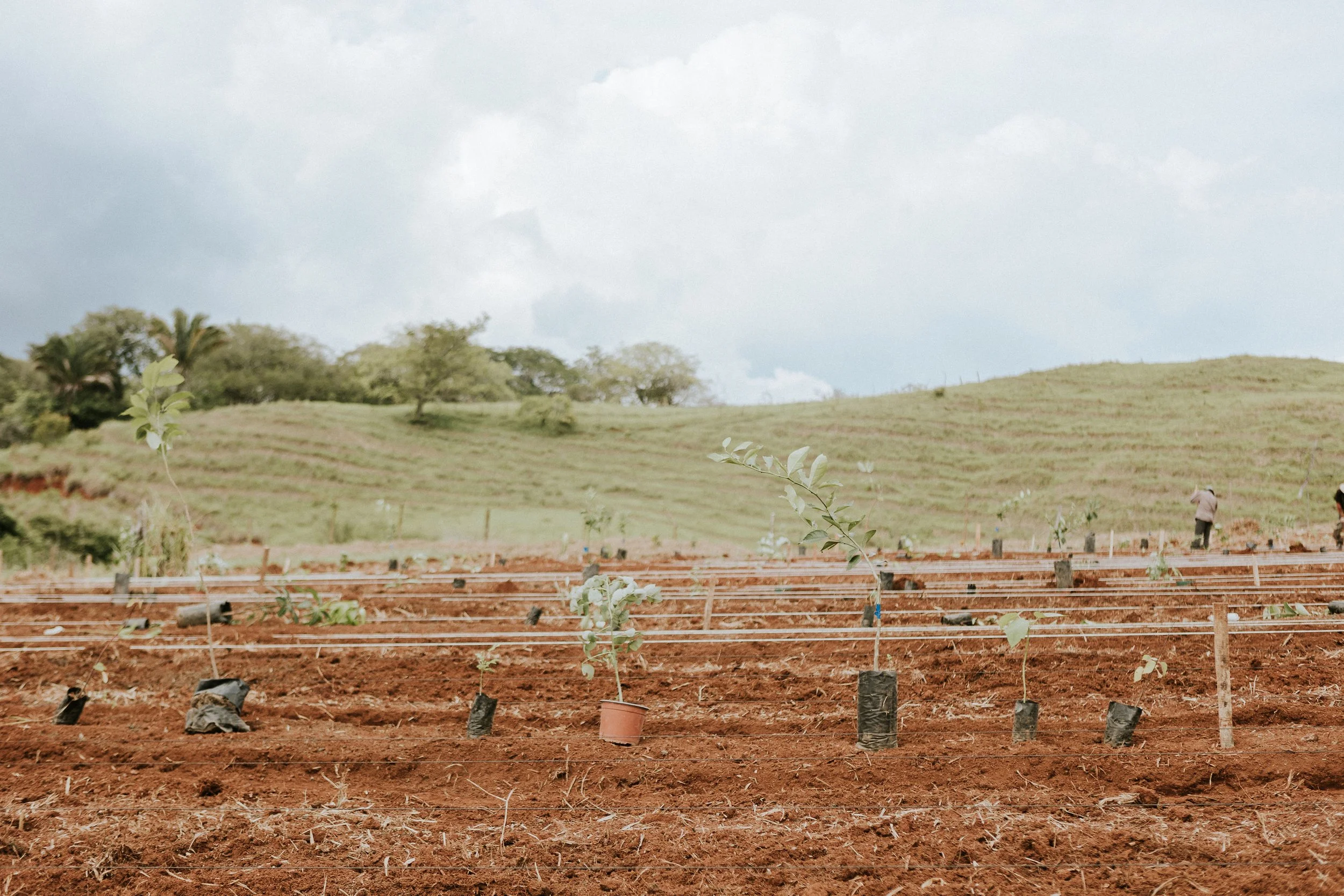
The off-contour rows, meanwhile, confirmed what Nat had told us. Working on the slope with one foot higher than the other, especially with a weed whacker running, is exhausting in a way that accumulates over a season. The off-contour rows were simply more comfortable, more efficient, and easier on the body. The theory said one thing. The land, our legs and our backs, said another.
Then came the dry season, and with it, the system's first real test. The species we had chosen were selected precisely because they are native or adapted to the tropical dry forest. In theory, they could handle it. But theory and a Guanacaste dry season are two very different things. By March of 2024, the system looked cooked. The soil was cracked, the leaves were curled, and the whole area had taken on that particular exhausted pallor of a landscape under drought stress. We had no irrigation, intentionally. If we are ever going to scale these systems across the farm, they need to survive on their own. We couldn't build a dependency into the foundation. So we watched, and we waited, and we let the system fight for itself.
As the rainy season approached, we did the one thing we could: we cut the dry clumps of Mombasa grass growing between the rows and laid the material across the soil of the tree lines, covering as much bare ground as we could. A few days later, the first rains arrived. And the response was immediate. The Mombasa grass exploded back to life, green and vertical almost overnight. The tree rows exhaled. The system, which had looked like it might not make it, remembered what it was supposed to become.
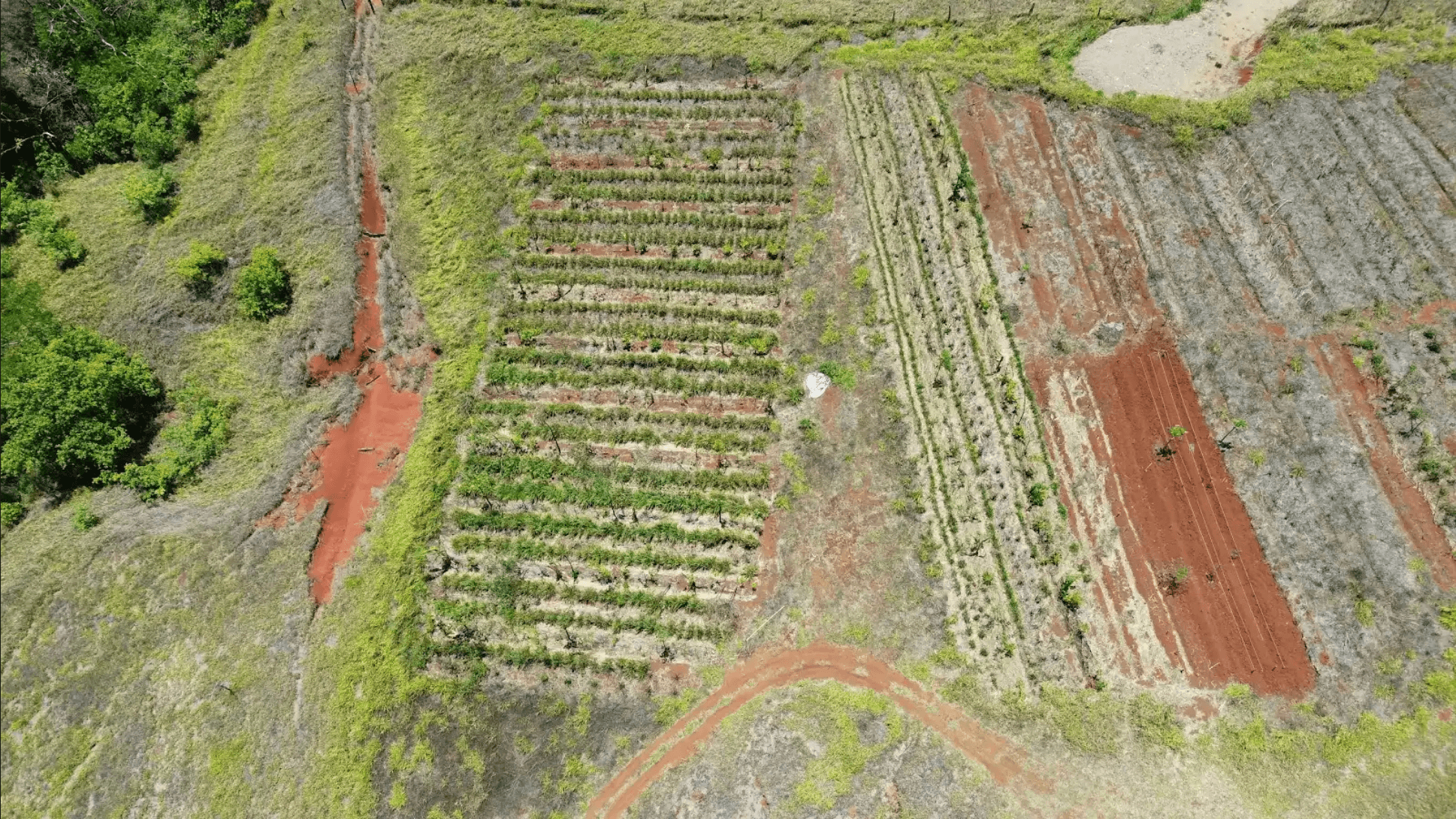
In June 2024, a year after the first planting, we hosted our second Syntropic Agroforestry course. Scott and Jorge returned as facilitators, Nat couldn't make it this time, and a new group of participants arrived ready to work. The task was to plant the second half of the original tilled area: the upper portion of the hill, sitting above the two on-contour rows we had planted the year before.
This time we were designing differently, informed by everything Phase 1 had taught us. The first decision was structural: we traced a path straight down the middle of the area, dividing it into a left side and a right side. One of the quieter lessons from the first planting was how much access matters. The on-contour rows, beautiful in theory, had become difficult to move through in practice. No central alley meant you had to walk the entire length of a row just to enter it. We weren't going to make that mistake again.
The two sides of the hill served different purposes and became an experiment. On the right side, we kept our initial approach: rows spaced 4 meters apart, a diverse mix of productive species, fruit trees, the same general design logic as the 2023 planting with a few refined species choices. On the left side, we tried something different. Rows spaced 8 meters apart, planted exclusively with pioneer species direct from seed, no fruit trees or grafted individuals. The idea was to let the pioneers grow fast and tall, generating as much biomass as possible, building soil fertility and fungal networks, and creating the conditions that more demanding productive species would eventually need. In a year or two, we would prune everything back hard, lay the material across the rows as mulch, and come in with a second wave of planting. Two different approaches, same hill, same rainfall, same soil. Let the land show us what works.
On both sides, between the tree rows, we broadcast Mombasa grass seed. By this point, we had come to see this grass as our key alley, our on-site compost factory. Rather than producing fertility somewhere else and trucking it in, the Mombasa grows right where we need it. We cut it regularly, lay it across the tree rows, and the system feeds itself. The pruning also does something less visible but equally important: it releases growth signals into the soil food web, triggering what practitioners call a growth pulse, a coordinated response from the microorganisms, the roots, and the plants above ground.
This is what we mean when we say we work with processes instead of inputs. We recognize and take responsibility for our ecological role within the system. Same as any other primate, we are orchestrators of ecological succession.
As we write this, the Ojoche System is in the middle of its second dry season. The land is scorched, the sky is clear, and the system is enduring, supported by the little condensation occuring at dawn. It is still suffering, we won't pretend otherwise, but it is suffering less than it did two years ago, and that difference is visible and measurable. The mango and cashew trees are doing remarkably well, holding strong against the whooshing Papagayo Winds. The native species we planted directly from seed, guapinol, carao, and nance, are quietly proving the point we learned in Phase 1: a plant that grows from seed in the exact soil it will inhabit for the rest of its life builds a resilience that no nursery can replicate.
Stand at the edge of the system and look out at the surrounding pasture and the contrast is already striking. Where the pasture is flat, oxidized and exposed, the Ojoche System has layers; canopy reaching upward, mid-story filling beneath it, ground cover binding the soil below. There is shade and structure, and there is life returning. Birds are moving through the rows, insects are working the flowers, wasps are building in the branches. No mammals yet, except us, but they will come.
During the dry season, we mostly watch and wait. We do a light pruning just before the dry season begins, removing dead branches, clearing spent flowers, giving the system a clean shape before it goes into survival mode, and then we largely leave it alone. Patience and hope are the key. We know that some species won't make it through. A few will die and leave a gap. But that is ok, that is the system telling us what belongs and what doesn't. We will replant when the rains return.
What don’t irrigate either. Not because we couldn't, but because we don’t want to. These systems need to learn to survive on their own, because the farm's ambition is larger than any single irrigation line can serve. We don’t want to build dependencies that we can’t replicate throughout the rest of the farm. So we let the dry season do what it does, and we prepare for the moment it ends.
That preparation has a ritual quality to it now. Around mid-May we move through the system cutting the dry Mombasa grass and laying it across the tree rows like a blanket. We do a light pruning on the trees, clearing anything dead or spent. And then we wait for the first storm. When it comes, the response is almost immediate; the grass explodes in green growth, the trees exhale, the soil microbiome wakes up.
And this coming rainy season, May 2026, the system will be asked to become something more. With three full years of growth behind us, enough canopy has formed in the off-contour rows to create the shade and the microclimate that coffee and cacao need to establish, at least during the rainy season. We will plant them between the existing tree rows, roughly two meters from each line. We are choosing coffee varieties selected for their adaptation to lowland conditions, not for premium cup quality, at least not yet. This is the next layer of the succession, the one we designed for from the beginning but had to earn the right to plant. A food forest is not built in a season or two. It is built in decisions that compound over years, each one made possible by the one before it.
When we first walked this land, silent, exposed, baking under the Guanacaste sun, it was hard to imagine it as anything other than what it was. That is the trick that degraded land plays on you. It presents its current state as a picture, frozen in time. But ecological succession is more like a movie that plays out over centuries. Every piece of land has memory, and given the right conditions, it remembers how to build a forest. We are just here to help it along.