
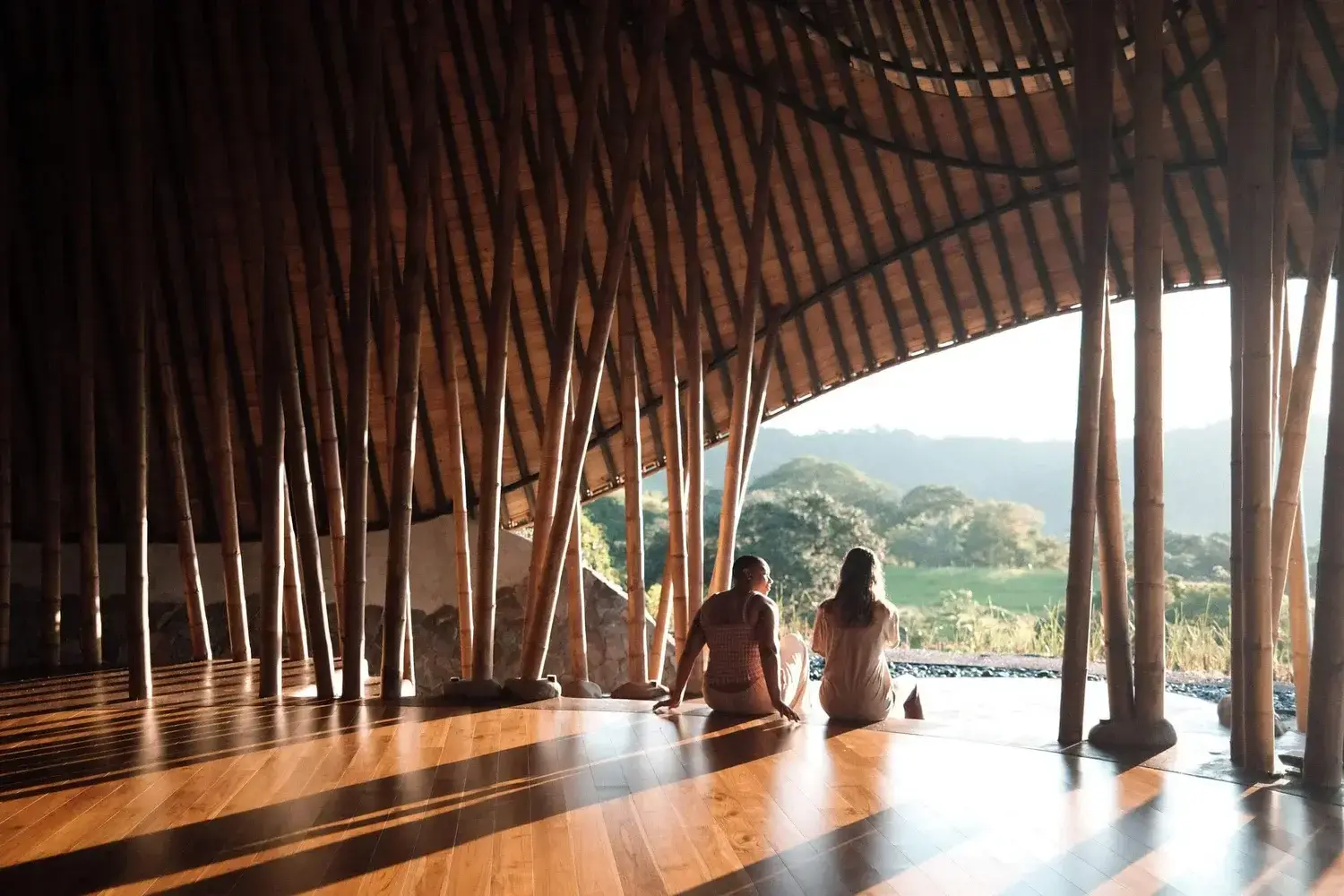
An ancient Moroccan technique meets biophilic architecture in Guanacaste, Costa Rica.
This is what it teaches us about designing with materials that breathe.

Biophilic design is often reduced to a vocabulary of plants, timber, and daylight. But the deeper proposition of the field, articulated by researchers like Stephen Kellert and practitioners across regenerative architecture, is that a building can do more than reference nature. It can behave like nature: respond to humidity, age with grace, regulate air, and offer the kind of textured, multisensory contact that human beings have evolved to find regulating.
Few surfaces embody that proposition more fully than Tadelakt.
In January, inside the Ibuku-designed maloca bathrooms at Tierramor, a group of students, architects, and apprentices gathered for our Earth & Lime Artistry workshop. Together they transformed the walls behind the washbasins into a surface that looks like polished stone, resists water without any synthetic sealer, and will quietly continue to react with the air around it for the rest of its life.
This is a story about that wall. It is also a story about what biophilic interiors can become when we stop thinking of materials as products and start thinking of them as participants.
Beyond Plants on Walls: Biophilia at the Material Scale
Most conversations about biophilic design happen at the scale of the room: a living wall here, a view of the canopy there. But the most consequential biophilic decisions are often invisible at first glance. They are made at the material scale, in the choice between a wall that off-gasses and a wall that purifies, between a finish sealed against the world and a finish in conversation with it.
A lime wall is alive in a literal sense. It absorbs carbon dioxide as it cures. It exchanges moisture with the air. It dampens sound. It carries no plasticizers, no acrylic binders, no petrochemical sealants. It belongs to a category of finishes - earth plasters, lime washes, clay renders - that share a single radical premise: that the inside surface of a building can be made of the same elemental matter as the ground it stands on.
Tadelakt is the most refined member of that family. And in a tropical bathroom that is humid, water-saturated, scented with soap and rain, its case becomes almost obvious.
Starting With a Material, Not a Product
Most modern finishes arrive pre-mixed, pre-tinted, pre-decided. You open the bucket and apply what is inside.
Tadelakt begins earlier than that.
Participants in the workshop mixed lime putty and finely ground marble powder by hand, learning the feel of the slurry before it ever met a wall. There is no shortcut to this part. Lime has its own pace, it draws in water, releases heat, stiffens when it wants to - and reading those cues is half the craft.
The word tadelakt comes from the Moroccan Arabic for "to rub," and that single verb tells you almost everything about what the process eventually demands. But before any rubbing, there is mixing, watching, waiting. Historically, the technique was used to waterproof the cisterns and hammams of Marrakech, drawing on nothing more than local limestone, marble, pigment, and time. Its persistence over centuries is not a quirk of fashion. It is a function of how well-matched the material is to the climates and rituals it serves.
What makes Tadelakt feel native to a biophilic interior is its performance:
- Mineral-based and low in embodied carbon , with a lifecycle that begins and ends in the earth.
- VOC-free , with lime that actively neutralizes airborne pollutants as it cures.
- Naturally water-resistant through chemistry, not coatings.
- Visually deep , with a luminosity and tonal variation no paint can reproduce. When color is introduced, it comes from natural mineral pigments folded directly into the plaster, so the color is not on the wall, it is the wall. During the workshop, pigments were trialed during testing, but the team kept the final surface in its raw mineral tone, allowing the soft greys and warm whites of the lime to read against the bamboo above.

Layer by Layer: The Architecture of Touch
Tadelakt is built up in successive fine coats. Early on, the wall looks like ordinary plaster - matte, soft, slightly raw.
Then something begins to shift.
As the lime starts to set, the surface is compressed and burnished. As in the Moroccan tradition this is done with polished river stones. Slow passes. Repeated pressure. Careful attention. Under the hand, you can feel the wall change phase: from a porous, breathable skin into something denser, glassier, more unified. The crystals of calcium carbonate are being aligned and packed. The wall is not drying. It is being transformed.
This is also where the biophilic logic of the technique reveals itself in a way that data sheets cannot capture. A burnished Tadelakt wall is sensorially complex in the same way a stone, a leaf, or a river-worn pebble is sensorially complex. Light doesn't just bounce off it; light moves through its top layer and returns slightly softer, slightly slower. The human eye reads this as depth, and the body reads it as calm. Researchers who study restorative environments have a name for this kind of perceptual texture: fractal richness. You don't have to know the term to feel its effect.
The Chemical Moment
The final step of the process is the one that surprises every workshop, every time.
The cured wall is treated with a potassium-based black soap, not as a topcoat, but as a reactant. The soap itself was produced on-site in Tierramor's biofactory, where bio-inputs for the gardens, the kitchens, and now the walls are made from regionally available raw materials. Its fatty acids meet the free lime still living in the plaster and form calcium stearate..
No acrylics. No silicones. No modern additives. Just chemistry between two ingredients that have been on the planet far longer than the practical surface they now protect.
For a space that lives with constant water, this matters in ways that go beyond performance. It means the wall has no plastic layer aging between you and the mineral. It means the surface can be re-soaped, re-burnished, repaired. It means the bathroom can be maintained the way a piece of cast iron or an old leather saddle can be maintained through care rather than replacement. That repairability is, increasingly, one of the most underrated principles of regenerative design.
A Conversation With Tradition
"True Tadelakt belongs to Morocco," Becky Gilling - the artisan plasterer who led this portion of the workshop shared. It uses specific Moroccan limestones, specific traditional mixes, and tools passed down through generations of master craftspeople.
What was made at Tierramor is more honestly described as Tadelakt-inspired, or Tadelakt-style. The principles remain. The chemistry remains. The materials and tools were adapted to what was available regionally: lime, marble powder, and sand sourced as close to the site as possible.
That distinction matters. Biophilic and regenerative design can drift, easily, into aesthetic borrowing, pulling visual language from places and traditions without engaging the ethics of sourcing or the realities of climate. The alternative, which we practice, is to treat traditional techniques as teachers rather than templates: to study what made them work in their original context, then ask what version of that intelligence belongs here.
The workshop was guided by Becky Gilling alongside Anna Kiesser (interdisciplinary artist and facilitator) and Cecilia Coronado (natural building architect). Together, they held a space where craft, architecture, and earth met through touch, attention, and patience - and where the question was never how do we copy this? but what does this tradition have to teach our place?
Why This Belongs Inside a Biophilic Building
Ibuku's maloca at Tierramor is already biophilic in the most legible sense: bamboo dancing, earthen flooring, organic geometry, daylight from every angle and vast views of the Guanacaste landscape. But a building like that can either be hollowed out by its interior finishes or completed by them. Glossy paint, vinyl, and polyurethane would have read as foreign material - sealed surfaces in a building designed to breathe.

A Tadelakt wall, by contrast, behaves the way the rest of the structure behaves. It exchanges moisture with the air. It registers light the way the bamboo overhead registers light. It will develop a soft patina over years of use, not because it is failing but because it is participating. In biophilic terms, this is what's sometimes called patina richness or evidence of life - the visual record of time and use, which the human nervous system reads as safety and belonging.
The wall behind a bathroom sink is, on the face of it, the least romantic surface in a building. It is also, in a humid climate, one of the most demanding. To meet that demand with chemistry rather than plastic, with hands rather than rollers, is a small but precise expression of what biophilic design actually proposes: that the everyday surfaces of our lives can be made of materials that age, breathe, and belong.
What Remains
By the end of the workshop, the wall behind the washbasins no longer looked like plaster. It looked like stone, seamless, soft to the touch, faintly luminous in the afternoon light filtering through.
But more than that, it held the memory of its making. Hands learning the slurry. Trowels passing again, and again, and again. An ancient Moroccan technique meeting Costa Rican bamboo and lime, and finding common ground.
These workshops are just as much technique as they are about restoring the relationship between people and materials, the relationship most modern construction has trained us out of. When you have spent three days mixing lime by hand, you do not look at a wall the same way again. You see what it is made of. You see whose hands made it. You begin to suspect, correctly, that the surfaces of a building are not neutral, and never have been.
A bathroom backsplash teaches you that, if it is built well.
